Start with your DAM, but aim for real content control
You chose your DAM system for a reason: centralized storage, a clean interface, and a solid foundation for managing your digital assets. And these platforms deliver on that promise. But here’s what often happens a few months in.
Your team is still manually exporting files for every campaign. Someone in marketing uploads the same image five times in five different sizes. Your website still shows an outdated product photo because nobody remembered to replace it. And when your agency asks for brand assets, you send a WeTransfer link.
None of this is a DAM problem. It’s a control problem.

Storage is not control
Most organizations using a DAM system are still using it like a very expensive shared folder. Assets go in. People search for what they need. Assets come out: manually, inconsistently, and often without governance. This is the gap between managing assets and controlling content.
- Managing means having assets organized, searchable, and centrally available.
- Controlling means knowing where every asset goes, how it gets there, what format it arrives in, whether it is compliant, and what happens when it expires.
Your DAM system gives you the first layer. DAM United adds the second, with vendor-independent expertise and solutions designed to make digital asset processes more efficient.
What a Content Control Center actually does
A Content Control Center is what happens when your DAM stops being a destination and starts becoming a hub.
Instead of:
- Manual exports → You have automated delivery via DAMlivery URLs.
- Multiple file copies → You have one asset with virtually unlimited format variants.
- Disconnected systems → You connect your DAM to your CMS, PIM, e-commerce platform, apps, and other systems.
- Missing content authenticity and AI labeling → Integrate information about content provenance, modifications, and AI-generated content into your content processes to create greater transparency and traceability.
Think of your DAM as the Source of Truth. DAM United provides the integration and automation layer. And DAMlivery is the engine that delivers the right content to the right place, in the right format, automatically.
What could content control save you?
Moving from simple storage to active content control isn’t just about workflow efficiency. It can have a direct impact on your bottom line. By automating asset distribution, you reduce the time spent manually exporting, resizing, renaming, and re-uploading files. At the same time, you can reduce the storage and operational overhead created by redundant copies across multiple platforms. With a centralized approach, teams continue working from the master asset while downstream systems receive exactly the versions they need.
Let’s keep the calculation simple:
- 1,500 assets per year
- 10 minutes of manual exporting, resizing, and uploading per asset
- €60 average hourly cost
That equals: 250 hours of manual work per year or approximately €15,000 annually. Now assume automation eliminates just 80% of those manual tasks. That means: 200 hours saved or approximately €12,000 every year.
Use this formula for your own organization:
(Assets per year × manual minutes per asset ÷ 60) × hourly cost × automation rate
A practical example with Fotoware Alto
Imagine a global brand using Fotoware Alto to manage its product photography. Before implementing DAM United integrations and DAMlivery, the workflow looks like this:
- A photographer uploads images to Alto.
- An editor exports, resizes, and renames files for each channel.
- Copies are distributed across shared folders for five different markets.
- CMS editors manually upload the files to each website.
- Six months later, an outdated image is still live on the German website.
With DAM United and DAMlivery, the process changes:
- The photographer uploads the asset to Alto via DAMupload, and the relevant metadata is applied.
- DAM United routes the asset to the required channels based on defined rules.
- DAMlivery delivers dynamic, on-the-fly image variants to the website via URL.
- When the master asset is updated in Alto, connected channels automatically receive the updated content.
The question to ask your team
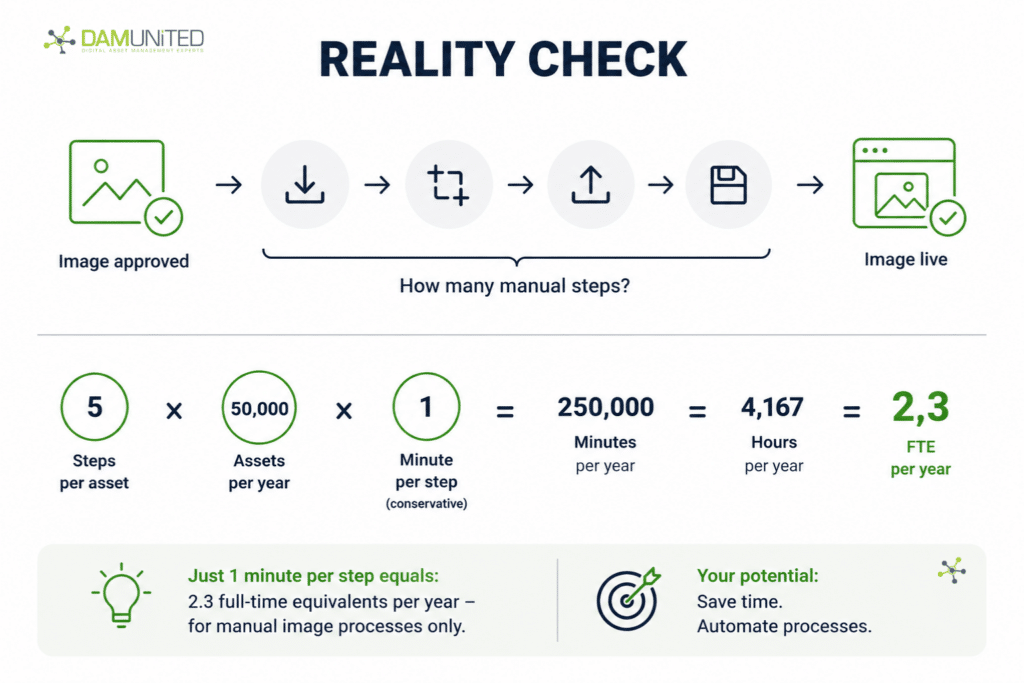
Ask three people, one each from marketing, e-commerce, and IT, how many manual steps sit between:
“Image approved” → “Image live”
That means live on your website, in your online store, in your PIM, or in any other relevant channel. Count those steps. Then multiply them by your annual asset volume. If the answer is more than zero, you have an opportunity to improve content control.
Your DAM is the foundation. Now make it work beyond the DAM.