Most organizations invest heavily in managing digital assets. Yet the real effort often starts after an asset has been approved.
An image is downloaded from the DAM, resized for the website, cropped for the webshop, optimized for email marketing and uploaded again into multiple systems.
The result is a growing number of duplicates, manual work and inconsistent content.
DAMlivery changes that process.
Assets stay in the DAM. Channels access them directly.
Problem 1: Every channel needs a different image size
⚠ Websites, webshops, newsletters and landing pages all require different image formats.
Teams often create multiple versions of the same image:
Original file
Website version
Shop version
Mobile version
Thumbnail
Every additional version increases complexity.
✔ Solution: Dynamic image delivery
DAMlivery generates image variants automatically.
One master asset is enough. Presets define dimensions, crops, quality settings and formats that are created on demand.
Benefits include:
Fewer files
Fewer duplicates
Consistent quality
Less manual effort
Problem 2: Large images slow down websites
⚠ High-resolution images improve quality but often hurt performance.
Slow-loading pages can result in:
Poor user experience
Lower conversion rates
Reduced SEO performance
✔ Solution: Use your existing CDN
DAMlivery delivers images directly. If needed your existing Content Delivery Network (CDN) can retrieve DAMlivery URLs on demand, cache the assets and deliver them globally with high performance and high availability.
The result:
Faster loading times
Reduced server load
Better website performance
Improved scalability
Problem 3: Updating images across channels is painful
⚠ A new product image is approved.
Now somebody needs to update:
The website
The webshop
Landing pages
Microsites
Outdated content often remains online longer than expected.
✔ Solution: One asset, many channels
With DAMlivery, every channel uses the same asset URL.
When the asset is updated in the DAM, every connected channel automatically displays the latest version.
No downloads. No uploads. No manual synchronization.
Typical use cases
E-commerce: Product images are delivered directly from the DAM and optimized for every device.
Landing pages: Marketing teams launch campaigns without exporting assets repeatedly.
Portals and microsites: Centralized content control combined with high performance.
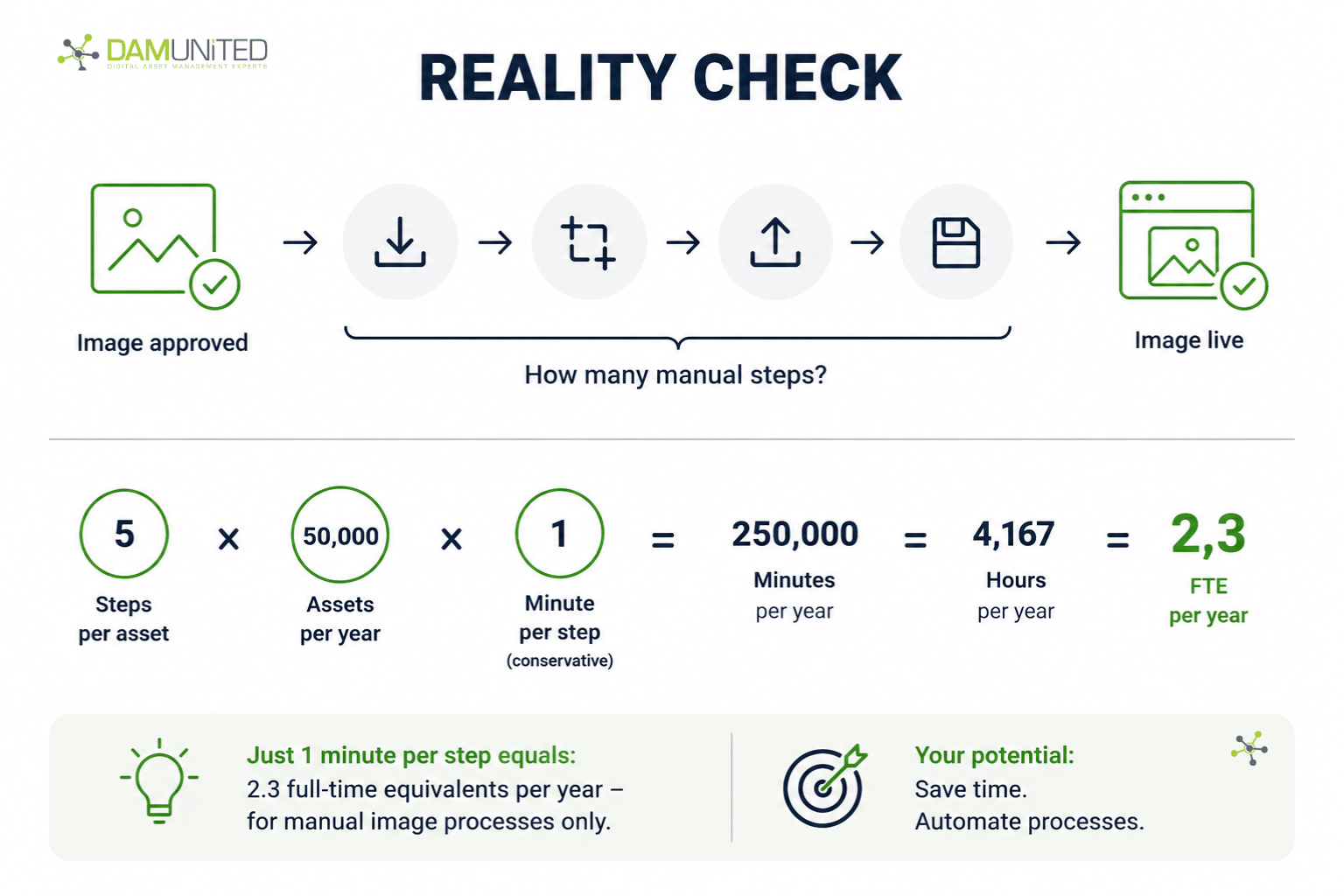
Reality Check
Count the steps between: “Asset approved” and “Asset live.”
How many times is an asset downloaded, edited, saved or uploaded again?
Multiply that number by your annual asset volume.
In many organizations, the result is one of the fastest business cases for process automation you’ll ever build.